the purpose behind what a buddhist does what s/he does

reposting this fb post to store this away in the storeroom as things in fb become lost overtime. it also allows an opportunity for pple who dun go on fb to have a chance to be in touch with the info.
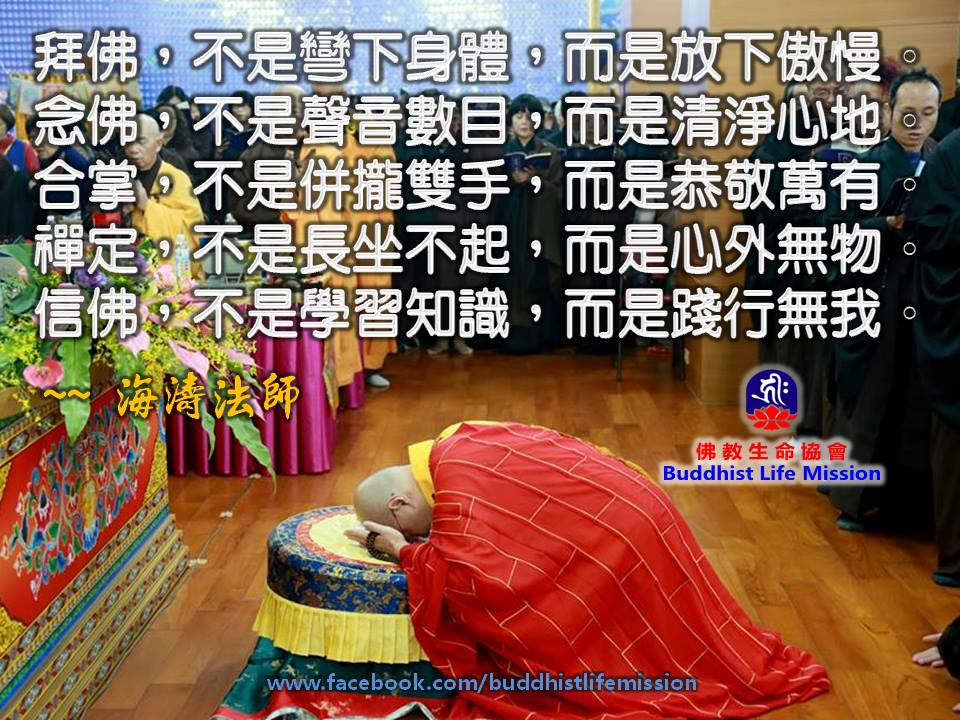
150113-purpose behind the action[acknowledgement: Buddhist Life Mission 佛教生命协会]

my attempt at translating the words:

拜佛,不是弯下身体,而是放下傲慢。
(to pay respect to Buddha, is not about the body bending, but laying down one’s ego.)

念佛,不是声音数目,而是清净心地。
(to chant, is not about the sound nor the quantity, but to clear one’s mind.)

合掌,不是并拢双手,而是恭敬万有。
(to join one’s hand _/\_, is not about putting both hands together _/\_, but to respect all things present.)

禅定,不是長坐不起,而是心外無物。
(to meditate, is not about sitting there for long, but to clear one’s mind of external existence.)

信佛,不是學習知識,而是踐行無我。
(to become a buddhist, is not about acquiring knowledge, but to learn and practise the path of selflessness.)

pulling all the 4 lines together:
To pay respect to Buddha, is not about the body bending, but laying down one’s ego.
To chant, is not about the sound nor the quantity, but to clear one’s mind.
To join one’s hand _/\_, is not about putting both hands together _/\_, but to respect all things present.
To meditate, is not about sitting there for long, but to clear one’s mind of external existence.
To become a buddhist, is not about acquiring knowledge, but to learn and practise the path of selflessness.

Amitābha 阿弥陀佛。

nibc 2005, flashback

was clearing some printed archives and found these two pieces of newspaper cuttings on National Interschool Blogging Championship 2005. forgot to note down the date, but based on analysis of the writing, these two articles should be published somewhere during the May 22-27 week of 2005.

141127-2005 nibc_st

141127-2005 nibc_zaobao

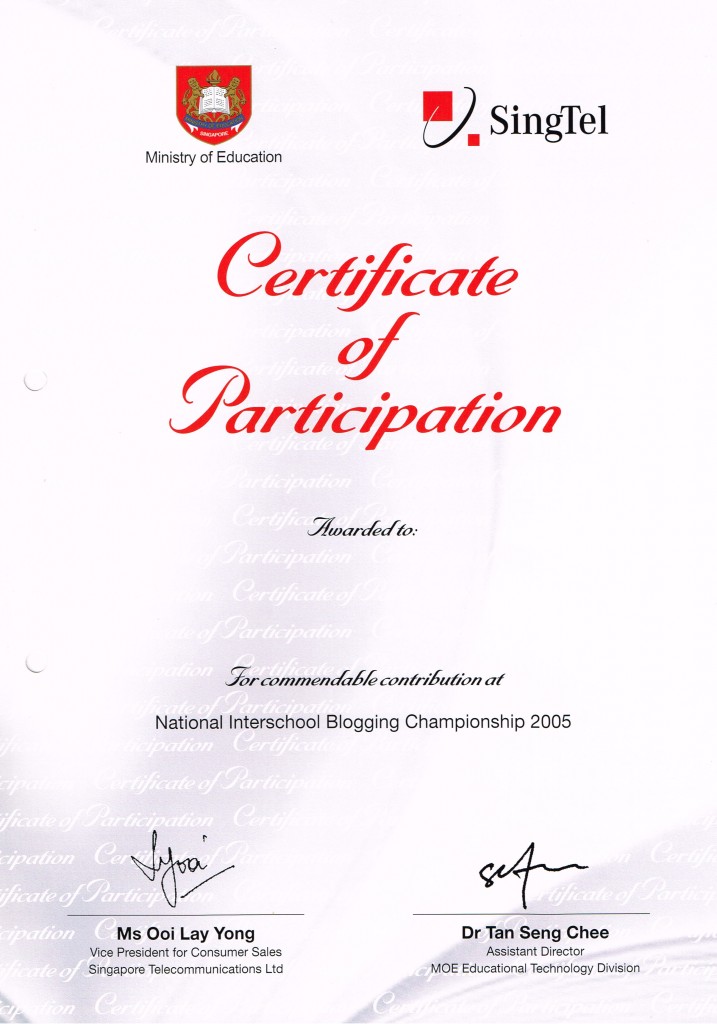
141127-2005 nibc_certificate

#iwonder if the impact on student participants’ learning experience back then has any residual effect till this day? 😛

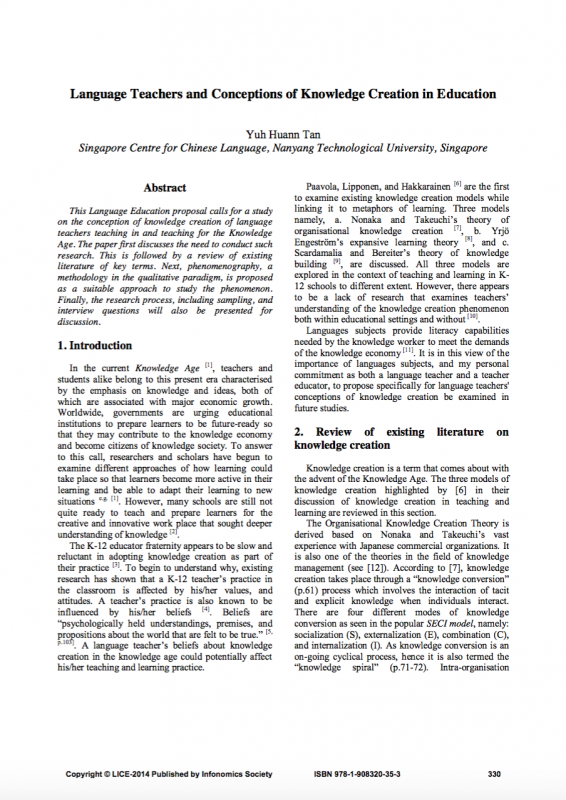
knowledge creation paper for LICE 2014

this is my paper for the London International Conference 2014.

150811-LICE2014

To cite: Tan, Y.H. (2014). Language teachers and conceptions of knowledge creation in education. In C.A. Shoniregun, & G.A. Akmayeva. (Ed.), Proceedings of London International Conference on Education LICE-2014 (pp. 330-334). London, UK: Infonomics Society.

alternatively, you may find the paper on academia.edu (:

a new meaning to 天時地利人和

always thought that 天時、地利、人和 is used when it refers to success not easily achievable, but many factors have to be aligned, many at times by chance. and the lack of one will result in non-success.

based on an incident that took place these two days, it seems that 天時、地利、人和 can cause a total failure, breakdown, or downfall. the lack of one, the failure/breakdown/downfall just wouldnt be complete or happen at all :O

must also credit 安琪 as the indirect source of inspiration (:

double rainbows (one barely visible) & lightning bolt after a thunder storm/shower

blended learning 的联想

a fellow co-learner in the course wrote this as part of weekly reflection activity:

“混成式的学习方式,和一般的面对面的上课学习,在时间上的付出更多。面对面的上课,一下课就是下课,可以不去管它了。但是混成式的学习方式好像不是这样,有帖子A,B,C,有贴1反2,有反思等等。对于“自主学习”和“协作学习”的概念,就一直跟着我,好像每一天都要拿出来在脑子里想一想。虽然每天都在想它们,想得很多很多,一有空就想,无时无刻都在想,但是要把所想的都打写出来,又没有那么多的时间。”

混成式学习的“阴魂不散”,其实所发挥的仅仅是ICT教学所提供的可能性,即每一个人,不受时空限制,只要有想法、有问题,都能够展开或进入学习的“状态”。

这里也深刻带出另一个问题,即ICT绝对和“省时”搭不上关系。或许在基本材料的准备从长远来看是省下了一些时间,但是作回复、为回复而事先搜索查证、阅读、理解,整理内容发帖子分享想法、问题,这些种种的种种都是需要大量精神与时间的付出的。

当学生都积极学习时,教师的“Happy Problem”出现了。试想,当班上40名学生的“学习引擎”若被我们开动了,那种学习所产出的排山倒海的内容不是一个教5班带200个学生的教师所能招架的。怎么办?!?

这或许就是为什么我们要培养学生的SDL和CoL。有了SDL的自我监控(无论是个人学习,或是对小组负责),都能省却教师一些“监控”的时间,转而把精神放在引导学生;有了CoL,小组内出现分工,学习不再是一个人的事,同侪间各有所得、各有长进。最重要的是,学习将是学生主动、教师辅动的意义建构中产生的。

我们目前的挑战或许是,有些华文老师也许觉得有太多的“课文要教”、“技能要教”。要让学生有机会负起SDL、CoL式的学习,或许还得从教师如何看待“学习”这回事着手,才有可能改变教学的设计。是这样吗?

感激老师的这一段反思,推进了我的思考 (: