meaning-making, losing it?

kueh attended a meeting and heard his boss huat shared on his latest beloved AI tool called LnbkM, and how he used it to summarise the so many readings and articles on the internet. boss huat encouraged all at the meeting to do what he does.
as kueh listened, he scratched his head and felt confused. slipping his hand into his left pocket, he took out his recipe and flipped to some notes he jotted down just last week, when attending a talk by a professor How PL who shared the following (research-based) ideas abt human learning:

  • learning is about meaning-making. and reading is a means through which meaning-making takes place.
  • neuroscience (brain-based) research also suggested that cognitive functions may be lost if they are unused or used less — comprehension, analysis, synthesis to just name a few

what boss huat suggested was to let AI be the one to “read”, and humans only receiving the summary of “reading” by the AI. if so, who is doing the meaning-making? kueh wondered what would be the future of humans be like if they begin to lose the brain functions of meaning-making? if so, what does it mean to be humans anymore?

rethinking meetings and decision making

what’s the purpose of calling (council/committee/team) meetings? decision making is one primary reason.

why decision making only during meetings? cos these decisions often need discussions to make meaning of best course of actions

why does “meeting” exist? cos pple who need to make decisions are busy with many other things in life, and meetings “guaranteed” and forced pple to set aside time, locked tgt in a space to discuss.

in the pre-internet age, this is absolutely essential. in the post-COVID19 age, workplace are already relying on WhatsApp and other messaging/meeting tools to discuss things and make decisions instead of only at “meetings”.

some held strongly to the idea of “decisions already made at meeting” = cannot be changed. why?

in the pre-internet era, there’s no way to conduct discussions without pple meeting (again).

in the post-COVID19 era, with group messaging apps such as WhatsApp, are discussions to enable meaning-making not possible? 

but no, the counter argument is cos meetings are recorded and noted (cf. minuted) and are “official”. in the internet era, digital records can be served as evidence in courts, are “meetings” necessarily more serious business than courtrooms? 

but again, no, cos face-to-face interactions lead to deeper discussions!? well, more dynamic perhaps; deeper, is questionable. cos meetings are time-limited and one hardly has time to draw additional references/resources to bring discussions deeper beyond that space and time defined.

a meeting is a gathering of humans, and thus human behaviours and psychology come into play. there’s always pple who are more passive and some who are more vocal at meetings. and gathering in a group hearing the more vocals can easily end up in group-think. why? it’s easier to agree than disagree, that’s the ‘lazy’ nature of brains, not to mention if one has some other things (family/workplace/whatever) on her/his mind. and no prize for guessing what’s the outcomes/decisions made in such “meetings”?

formal meetings are still needed. cos the society expects it, and there are decisions that would warrant deeper deliberations face-to-face dynamically. but the argument that decisions made at meetings are cast in stone and cannot be changed warrants a rethink as discussions are now enabled by technologies and “recorded”. especially for decisions made when the more knowledgeable others are absent and the rest are discussing “in the blind” if not less knowledeable.

if ideas can be improved and decisions can be improved outside “meetings”, why do some pple dearly hold on to meetings (and the decisions made at meetings) conceptualised by last century definition? well, mindset, beliefs, and values are the most difficult to shift (not impossible), not any amount of SkillsFuture credits would make it easier. something all too familiar to educators and researchers in the field of educational psychology and learning sciences (:

only good and good-er

realised i have not posted to elaborate on the philosophy of ‘good-er’ although i have used the term in a few posts in the past. so shall do it now.

yes, it’s non-existent in English and a grammatically wrong word.
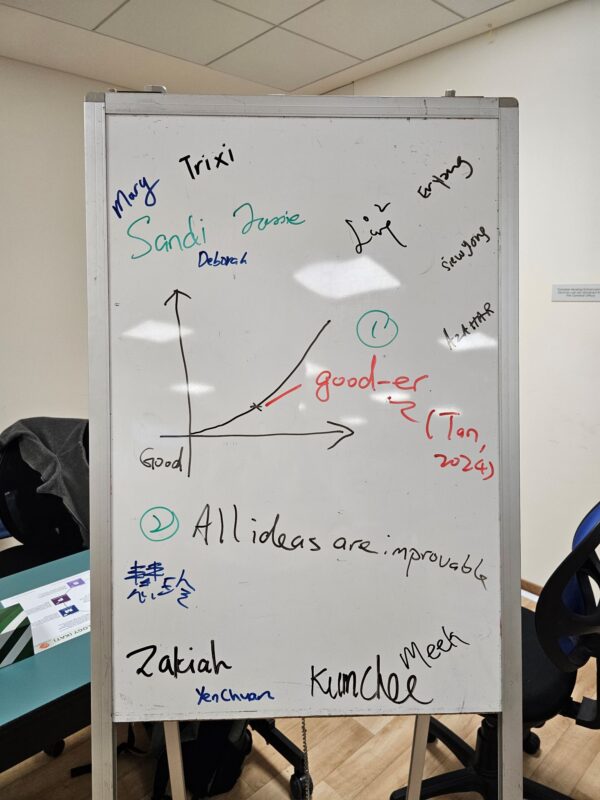
but guess that made the word stands out even more, cos in the ‘good-er’ worldview, there’s no right or wrong; only good, and good-er exist. the philosophy can be interpreted as an extension of the core of the 12 principles of knowledge building (Scardamalia, 2002; Scardamalia and Bereiter, 2006), i.e., improvable ideas.

often, in the ‘right vs. wrong’ world, it’s not uncommon that we hear: ‘this idea is stupid, it is wrong, it’s unacceptable’… and pple began to dismiss their own and others’ ideas and not to mention the emotional side of things, bad, sad, angry …
contrastingly, in the ‘only good and good-er’ world: ‘all ideas are good ideas!”. marrying it with kb’s principle of improvable ideas, all ideas become improvable. end result: all good ideas can and will only become good-er ideas over time.

the good-er philosophy was first instituted as part of my design/model for blended learning for CL teachers’ professional development. it was my research project between 2015-2016 when i was with the SCCL. it’s the first ‘rule’ (among three) that my community of teachers adopt: “只有好,和更好”。 so if u ever need to cite a source for the good-er theory/philosophy, you could either use this blog post (Tan, Y. H. (2024, November 9). Only good and good-er. Edublog.net. https://edublog.net/2024/11/09/only-good-and-good-er/ ), or my handbook if you prefer an earlier source:

Tan, Y. H., Tan, Y. N., & Chow, F. Y. (2019). Blended learning for in-service teachers’ professional development: Handbook for new instructors. Singapore: NTU-SCCL Press.
OR
陈育焕、陈雁妮、周凤儿 (2019). 混成式在职教师培训:新手指导员手册 [Blended learning for in-service teachers’ professional development: Handbook for new instructors]。新加坡:南大-新加坡华文教研中心出版社。

Nov 7, 2024, Co-generative dialogue on educational research @RGS

towards only good and gooder!

Tan, Y. H. (2024, November 9). Only good and good-er. Edublog.net. https://edublog.net/2024/11/09/only-good-and-good-er/

p.s. scan QR code for a draft of the handbook — Tan, Tan, & Chow (2019) — that documented the 2015-2016 research

visit to central library

thanks 8bro R for establishing the connections and making our visit to central library possible. it’s been a while since my last visit to national library (aka central library, or officially central public library). eye-opening to see how a brick and motar library (of yesteryears) is renewing itself relevant in this digital era, where pple consume, if not overwhelmed by, multimedia more than words-only media. and my theory behind this sight – the power of mission (aka v&m).

so what’s the takeaways from the visit to personal l&d? well, it’s not new but more of a reminder perhaps, that connecting mission (& vision) for your pple (from a leadership perspective) is key/critical. what’s the meaning of ‘library’ today or tomorrow? how does that laying one brick contributes to the building of a skyscraper. how many pple look at a building and think of the individual bricks (or blocks)? cos it doesn’t really matter. but to the worker, it may mean something (aside than the salary $ of cos).

mission gives meaning to who are we? why are we ‘here’. and leaders remind pple of meaning with the mission (it’s part of their job). otherwise, it’s easy for individuals to forget why they are doing what they’re doing (forgetting is human nature; possibly neuroscience evidence too). say, looking ard us now, it’s the mission clearly articulated (and regularly reminded)?

(image credit: https://nus.edu.sg/osa/keviihall/open-house-2024)

a final random thought that pops up — even when i was a hostelite, we had a ‘mission’ – “we are full-time hostelites, part-time students”.

on PLC for organisational KM and knowledge creation perspective

Individuals come, individuals leave (retire, switch career, 躺平, whatever). How does an organisation ‘retains’ as much tacit institutional knowledge as possible? Documentations, guides, playbooks are some ways, but these have their limitations. Why? Becos meanings are not hard cold words, graphics, and videos, print, online, or otherwise. Humans are social beings, and meanings are socially negotiated in respective social contexts.

Communities (or societies?) are where knowledge ‘resides’, some pple would say. By forming professional learning communities (PLC; or otherwise commonly known as CoP, although the term ‘CoP’ includes various conceptions due to different interpretations of what “communities” meant), organisations create an additional avenue for retaining tacit institutional knowledge. But the value goes beyond knowledge retention (if knowledge can be ‘retained’; also note that documents, guides, playbooks stop here). Members of a PLC, through regular interactions, create new knowledge. Thus, the body of organisational knowledge continually grows and renews.

People in PLC don’t necessarily work together every day, but they are bounded by their respective activity systems at work, which may not be conducive for knowledge creation. In the PLC activity system, rules that encourage learning and creating knowledge together can be negotiated and practised by the community.

references: Engeström (1987);Wenger, McDermott, & Synder (2002)