logical fallacies

chanced upon this site “Logical Fallacies and the Art of Debate” that prof Glen Whitman had prepared for his students some 11 yrs ago relating to the use of logical fallacies during debates. many of these can be observed in arguments observed or experienced in our daily lives, not just in a debate setting.

Argumentum ad antiquitatem, Red herring, and Slippery slope are but three examples (:

an extract from Walden Two

saw the following quote from the book Walden Two while reading an article:

Since our children remain happy, energetic, and curious, we don’t need to teach “subjects” at all. We teach only the techniques of learning and thinking. As for geography, literature, the sciences-we give our children opportunity and guidance, and they learn for themselves. In that we dispense with half the teachers required under the old system, and the education is incomparably better. Our children are not neglected, but they’re seldom, if ever, taught anything.

Education in Walden Two is part of the life of the community. We don’t need to resort to trumped-up life experiences. Our children begin to work at a very early age. It’s no hardship; it’s accepted as readily as sport or play. A good share of our education goes on in workshops, laboratories, and fields. It’s part of the Walden Two code to encourage children in all the arts and crafts.

(Skinner, 1948, pp. 119-120, as cited in Anderson, Reder, & Simon, 1997)

classroom, the return

it’s been 7 yrs since i was away from the classrooms, away from teaching, away from marking, away from graduating students, away from the whole list of roles and responsibilites. today, marks a day in history where i returned to the classroom, and ‘graduated’ students, not from the school, but from a course, the ICT for Meaningful Learning (aka QED 527). the fellow teachers in my tutorial group 8 belong to the january 2012 intake.
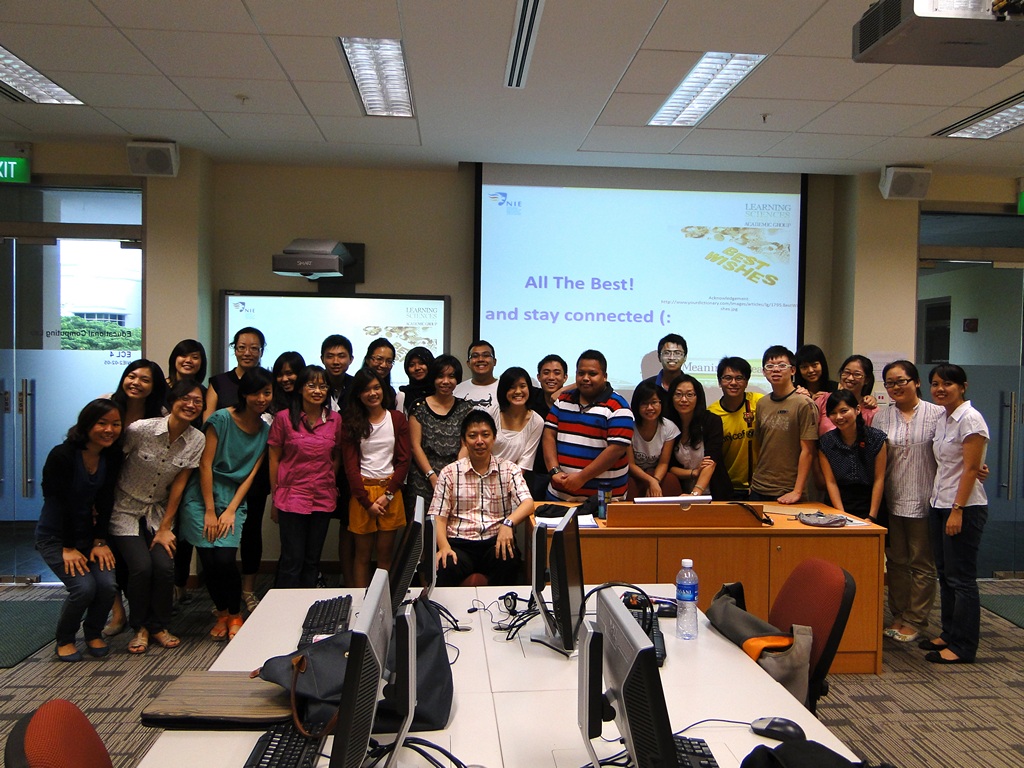
(from left to right, in order of appearance, regardless of front or back): Low Yee Lin, Fu Hsun, Oh Siew Gein, Huang Yin Chiao, You Lixia, Zhang Rui, Lim Xin Yi, Serene Eng, Kenny Wong Boon Chong, Koh Xue Ting, Lee Chain Ting, Nurul Musfirah, Huang Chenmei Juliet, Jacob Jonathan, Wee Wen Jie Melissa, Linus Chan, Mohamed Hafiz bin Mohamed Ridwan, Shian Pui Kuen, Zhuang Junming Edwin, Shang Xiaoyan, Chew Kechang, Ong Zi Xiang, Cheu Siew Lan, Chang Qi Yin Zoe, Dai Qi, Deng Kaihua, & Lim Kaihui. (not in picture Melanie Kee)

all the best to one and all (:
no more bad wines

last week, boss sc shared with us the following TED video while mentioning the idea of work-life balance:

i neither drink nor collect wine, but this video truly serves as a good reminder on how we want to live our life. “priorities” some might say, but i would think the lesson of the day is the ‘how’ and not the usual ‘what’. cos many at times, we know what we want, but we may neglect the how to approach it, which is more important i feel.

for the case of no more bad wines, these are my two resolutions:

  1. i choose to be happy in whatever i do (for e.g. teach, learn, relating to pple, etc.)
  2. be a great husband & dad

what’s yours? 😉