does “teachers teach the way they learn” work for CL teachers?

observing our current recruitment strategy, we appear to be recruiting teachers who have learnt well in a certain subject/field to teach that subject. from here, we could assume that teachers recruited to teach a subject is a successful learner of that subject.

we often hear “teachers teach the way they learn” (citation needed), it follows that a physics teacher will teach the way(s) s/he’ve learnt physics well, and students could model those method(s) and learn well too. likewise, a maths teacher will teach the way(s) s/he’ve learnt maths well, and students could model those method(s) to learn maths well. for such ‘wholesale’ teaching of a successful way to another, it assumes that the learner profile of the teacher when s/he was a student is similar to that of the students s/he is teaching right now. but often, our students are unique individuals with diverse backgrounds. such ‘wholesale’ teaching may not work, not to mention pedagogies advance with time.

pedagogy aside, the ‘content’ is another consideration. is “physics” or “maths” 15-20 years ago the same “physics” or “maths” we are referring to today? in other words, are teachers learning the same (or more or less the same) thing as their students when they were students? the nature of content affects how learning takes place too. and this in turn affects the idea of how a subject could be learnt well. self-examination of a teacher is important to raise self-awareness of this issue.

if we were to look at “maths” 15-20 years ago, we could perhaps observe some differences in topics to b taught/learnt at different levels over time. while pedagogies may advance, content-wise “maths” is still largely “maths”.

if we were to examine a CL teacher, i assume a teacher is recruited to teach CL because s/he learns CL well. a CL classroom >15 years ago is largely a teacher-centered classroom, with classroom discourse patterns largely limited to simple IRE. assuming a teacher learns CL well back then, is it appropriate for him/her to “teach the way they learn”? pedagogy aside, is the learner profile of the teacher when s/he was a student similar to that of students s/he is teaching right now? based on the trends of increasing English-speaking homes (around 60% in 2010), there is a higher chance that a present CL teacher grew up in a Chinese-speaking home. in other words, these teachers are learning CL as a first language. and the chance of them teaching students learning CL as a second language is on the rise, and ever increasing. from a language learning point of view, learning CFL and CSL require two entirely different approaches. before we ask if teachers are teaching these two groups of learners with distinct pedagogies, a lower level question to reflect on is, are teachers aware that their “CL” is not “CL” (cf. Maths)? in other words, not many, if not most, CL teachers can “teach the way they learn”?

i believe teachers know “time has changed; things are different”, but i’ve not had the chance to conduct a research on the awareness at this lower level. compared to his/her Maths colleague, a CL teacher is almost not teaching “CL” as s/he have learnt in the past. yes, there would be CL teachers who grew up learning CSL (cf. curriculum’s definition of second language), but at present, lack of official statistics, my guess is such number is few.

hence, the importance of developing reflective practitioners so that a CL teacher may always be aware of the different issues to be considered as s/he goes about designing his/her learning activities for students. fundamentally, “teachers teach the way they learn” has a minimal chance of working for CL teachers.

thinking photo (photo credit: “Thank you” unsplash)

reflection on 12470-00004 facilitation

it’s been 3 weeks since the course started on 2/6. this is the first time Clinic is conducted with 3x face-to-face. an additional f2f session’s added in between based on our own reflection of the past runs, and participants’ feedback.

this time round, we have 7 participants who came. 1 MIA-ed, while 1, prior to the first f2f, was advised to sign up for the next run as the teacher couldn’t make it for this afternoon’s f2f, and the final f2f. during the first f2f, i learnt that another of the 7 belongs to this case. would have advised the teacher similarly if we were to know that in advance.

in the past 3 weeks, i observed 3-4 active participants. there were only 4 帖子B, and 3 weekly reflection piece from 2 participants. 2 reminder emails were sent, and only 2 echoes returned. not sure what happened to the rest. my guess is that our friends could have returned to PRC during this sch hols, and they faced difficulties accessing OPAL, ICON and/or fb due to the Great Firewall. will need to learn the real reasons behind if they were to turn up.

based on the 4 帖子B, i observed 3 of the participants were actively integrating ICT into their teaching and learning activities. except one, the awareness of conceptions of SDL appeared to include only incidental SDL along the SDL spectrum. consequently, the use of ICT to facilitate SDL reflects that understanding.

in the session later, my plan is to facilitate discussions to deepen the conceptions of SDL of participants. along with this, the affordance of ICT to facilitate SDL. would need to see how i could tie in what i have planned with their individual 5-10 minutes sharing.

looking forward to a fruitful session later. if time allows, we could even explore the design and use of rubrics as self-monitoring and self-management of learning cannot do without this important scaffold/tool.

sunrise photo(acknowledgement: jinsngjung)

automatic chinese transcription

transcribing voice recordings is a painful process for non-professional transcribers like me. if only one can pipe the recordings into a computer, and the transcription will be automatically done. wait, yes, it’s possible now, albeit with a relatively low-mid accuracy.

thanks to Si Hui who introduced to me someone’s attempt to convert recorded audio to text on a Mac that started my exploration in the Windows environment (:

the software that you will need to transcribe Chinese audio recordings into Chinese text:

1. Audacity (or any audio playback software that allows you to select the Output path)

2. VB-Audio Virtual Cable (or any other software that captures all the Sound Out, and directs it to any system software listening to any audio output; this is the Windows equivalent of MacOS’ Soundflower)

3. 讯飞输入法 iFly Input PC version (this is the software responsible for the Chinese audio-to-text conversion)

install the above software in any order. to get them working together, follow these steps:

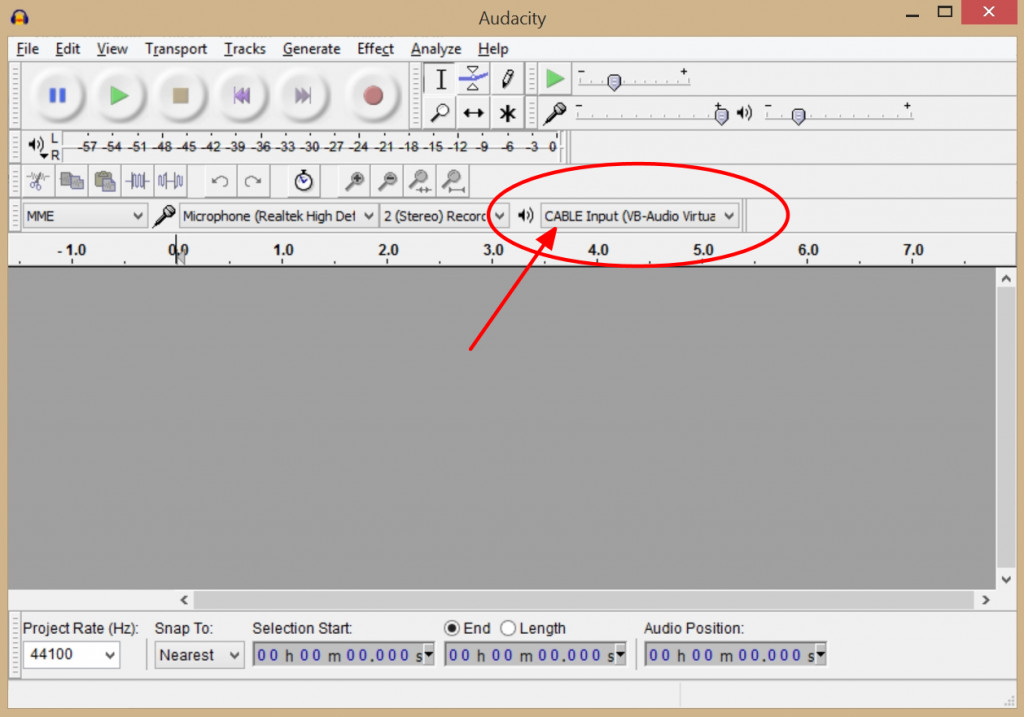
1. load Audacity. open the voice recording. In the “Audacity Device Toolbar”, select Playback Device and set it to CABLE input (VB-Audio virtual cable).

150606-audacity-playbackoutput

2. load 讯飞输入法’s 语音悬浮窗 (find it within Start menu). click on the 语音悬浮窗 to set it to “点击说话” to pause recognition.

150606-ifly-pause

3. load any word processor (e.g. microsoft word, notepad).

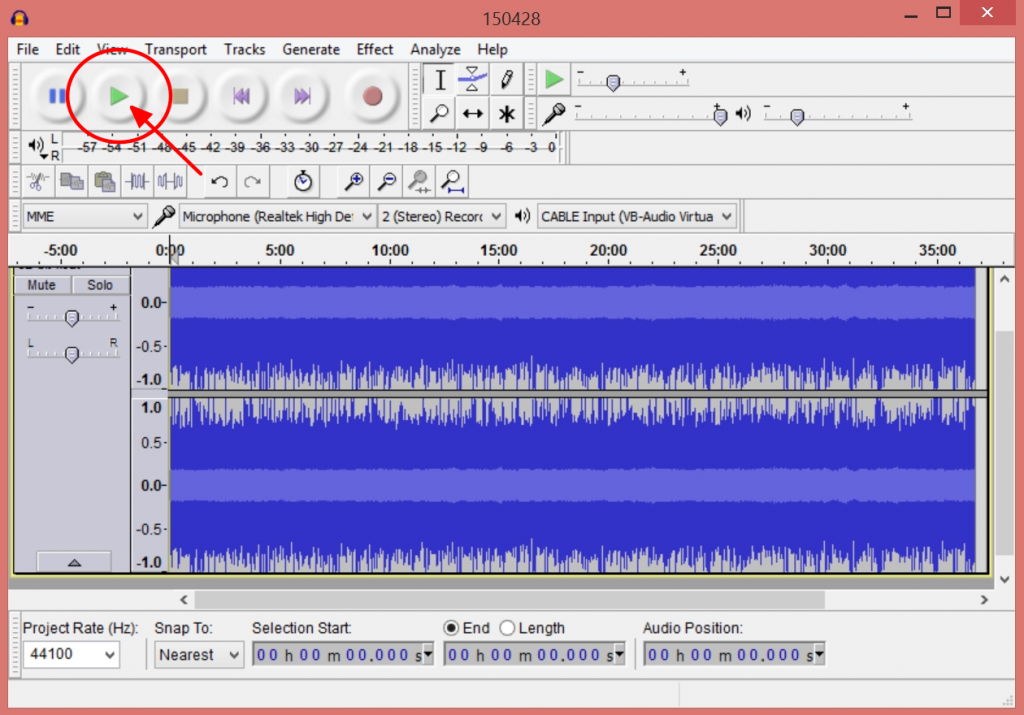
4. go back to Audacity. begin Playback of voice recording.

150606-audacity-play

5. click on 语音悬浮窗 to set it to “请说话” (voice recognition begins)

150606-ifly-start

6. switch to word processor, and maintain it as focus (with blinking cursor in text edit area)

7. your automated transcription should now begin, as follows:

things to note:
1. 讯飞输入法 requires an ACTIVE internet connection to function.
2. 讯飞输入法 may from time to time stop by itself. i think this happens when the server is too busy. one will need to repeat step 5 to reactivate the audio-to-text conversion.
3. if you would like to use Windows 8.1’s built-in voice recognition software, pls go ahead. but i can safely advise, be prepared to get near-zero accuracy. maybe the to be released windoze 10’s version would be better 😛

once it’s done, it’s time listen to your original voice recording, and begin the cleaning up of the automatically generated text. while the recognition accuracy is still not high enough, this process has however sped up my rate of transcription significantly. your mileage may vary, but i hope it helps in your work too.

oh btw, my all-time favourite software to assist in transcription remains as VoiceWalker.

enjoy (:

小男孩、学校、画画

以下这则小男孩的故事取自《人性的优点故事全集》之第20章保持自己的本色。这本电子书可到百度阅读上免费下载全文。

从前有个小男孩要去上学了。他的年纪太小,而学校看起来却是那么大。 小男孩发现进了校门口便是他的教室时,他觉得很高兴。因为这样学校看起来就不再那么巨大。

一天早上,老师开始上课,她说:“今天,我们来学画画。”那小男孩心想:“好哇!”他喜欢画画。他会画许多东西,如:狮子和老虎,小鸡和母牛,火车以及船儿。他开始兴奋地拿出蜡笔,径自画了起来。但是,老师说:“等等,现在还不能开始。”老师停了下来,直到全班都专心看着她,老师又说:“现在,我们来学画花。”那男孩心里高兴。他喜欢画花儿,他开始用粉红色、橙色、蓝色蜡笔,勾勒出他自己的花朵。但此时,老师又打断大家:“等等,我要教你们怎么画。”于是她在黑板上画了一朵花。花是红色的,茎是绿色的。“看这里,你们可以开始学着了。”小男孩看着老师画的花,又再看看自己画的,还是比较喜欢自己的花儿。但是他不能说出来,只能把老师的花园在纸的背面,那是一朵红色的花,带着绿色的茎。

另一天,小男孩进入教室,老师说:“今天,我们用黏土来做东西。”男孩心想:“好棒。”他喜欢玩黏土。他会用黏土做许多东西:蛇和雪人,大象及老鼠,汽车、货车——他开始捶揉成球状的黏土。 老师说:“现在,我们来做个盘子。”男孩心想:“嗯,我喜欢。”他喜欢做盘子,没多久各式各样的盘子便出笼了。但老师说:“等等,我要教你们怎么做。”她做了一个深底的盘子,“你们可以照着做了。”小男孩看着老师做的盘子,又看看自己的。他实在比较喜欢自己的,但他不能说,他只是将黏土又揉成一个大球,再照着老师的方法做。那是个深底的盘子。很快的,小男孩学会等着、看着,仿效老师,做相同的事。很快的,他不再创造自己的东西了。

一天,男孩全家人要搬到另外一座城市,而小男孩也只得转学。这所学校甚至更大,教室也不在校门口边,现在,他要爬楼梯,沿着长廊走,才能到达教室。

第一天上课,老师说:“今天,我们来画面。”男孩想:“真好!”他等着老师教他怎么做,但老师什么也没说,只是沿着教室走。老师来到男孩身边,她问:“你不想画吗?”“我很喜欢啊!今天我们要画么?”“我不知道,让你们自由发挥。”“那,我应该怎样画呢?”“随你喜欢。” 老师回答。“可以用任何颜色吗?”老师对着他说:“如果每个人都面相同的图案,用一样的颜色,我怎么分辨是谁画的呢?”于是,小男孩开始用粉红色、橙色、蓝色画出自己的小花。

小男孩喜欢这个新学校,即使教室不在校门口边。

感想阿宝老师与我分享了这则小故事。
你若果是名教师,这则故事引起了你的任何感想,或是有所共鸣?(:

150521-nanhaidegushi