
visit to central library

thanks 8bro R for establishing the connections and making our visit to central library possible. it’s been a while since my last visit to national library (aka central library, or officially central public library). eye-opening to see how a brick and motar library (of yesteryears) is renewing itself relevant in this digital era, where pple consume, if not overwhelmed by, multimedia more than words-only media. and my theory behind this sight – the power of mission (aka v&m).

so what’s the takeaways from the visit to personal l&d? well, it’s not new but more of a reminder perhaps, that connecting mission (& vision) for your pple (from a leadership perspective) is key/critical. what’s the meaning of ‘library’ today or tomorrow? how does that laying one brick contributes to the building of a skyscraper. how many pple look at a building and think of the individual bricks (or blocks)? cos it doesn’t really matter. but to the worker, it may mean something (aside than the salary $ of cos).

mission gives meaning to who are we? why are we ‘here’. and leaders remind pple of meaning with the mission (it’s part of their job). otherwise, it’s easy for individuals to forget why they are doing what they’re doing (forgetting is human nature; possibly neuroscience evidence too). say, looking ard us now, it’s the mission clearly articulated (and regularly reminded)?

(image credit: https://nus.edu.sg/osa/keviihall/open-house-2024)

a final random thought that pops up — even when i was a hostelite, we had a ‘mission’ – “we are full-time hostelites, part-time students”.
on PLC for organisational KM and knowledge creation perspective

Individuals come, individuals leave (retire, switch career, 躺平, whatever). How does an organisation ‘retains’ as much tacit institutional knowledge as possible? Documentations, guides, playbooks are some ways, but these have their limitations. Why? Becos meanings are not hard cold words, graphics, and videos, print, online, or otherwise. Humans are social beings, and meanings are socially negotiated in respective social contexts.

Communities (or societies?) are where knowledge ‘resides’, some pple would say. By forming professional learning communities (PLC; or otherwise commonly known as CoP, although the term ‘CoP’ includes various conceptions due to different interpretations of what “communities” meant), organisations create an additional avenue for retaining tacit institutional knowledge. But the value goes beyond knowledge retention (if knowledge can be ‘retained’; also note that documents, guides, playbooks stop here). Members of a PLC, through regular interactions, create new knowledge. Thus, the body of organisational knowledge continually grows and renews.

People in PLC don’t necessarily work together every day, but they are bounded by their respective activity systems at work, which may not be conducive for knowledge creation. In the PLC activity system, rules that encourage learning and creating knowledge together can be negotiated and practised by the community.

references: Engeström (1987);Wenger, McDermott, & Synder (2002)

on epistemology and etymology

saw the following quote in petraeus’s post:

“When confronted with two things that have an appearance of accuracy, most people will choose the one that is more appealing to them.”

and it totally resonated with an observation made 2 days ago. this story began with a casual flip of a ForwardSG booklet that was distributed free with the printed Zaobao. and the casual flip turned up an observation (looks like the casual mode did not disengage the analytical mind):

(click here for image (pwd))

there was a problematic expression. it should have been “取诸社会,用诸社会” (meaning: giving back to society what’s obtained from society).
but “诸” is a word from old Chinese and it’s seldom used and considered more difficult in contemporary Chinese today. however, the second of “诸”‘s multiple meanings in old Chinese can be represented by two simple words of today: “之于”。in other words, 诸 = 之于 (could be interpreted as: from). hence, if “诸” is difficult and not used, a more understandable and accurate expression would be “取之于社会,用之于社会”。but it is lengthy.

so why is “取之社会,用之社会” problematic from an etymology’s perspective? noticed the omission of 于 from the original 之于? none of the 12 meanings of “之” can make sense in this expression. pls let me know if you can interpret otherwise.

what if it were “取于社会,用于社会”? the 3rd meaning of “于” actually makes total sense and can be used to replace “诸” while still retaining its original meaning.

in short, “取之社会,用之社会” is totally meaningless etymologically. but, a quick google actually revealed that pple used and published “in “wrongly” . why? well, not everybody is etymologically-aware; how many of these writers are familiar if not linguists in old Chinese? and in our busy-ness, anything that ‘sounds’ correct goes? afterall, if something sounds ‘weird’, just repeat it 10 times verbally, and it’ll sound “just fine” — a ‘trick’ taught to me by my linguistic professor some 25 yrs ago.

and does something that appear in publications makes it (more) right? this is an epistemic question that was posed to me by my supervisor when i was doing lit review for my doctoral thesis.

to be fair, google also revealed pple pointing out what’s right, for example, here and here. but as per petraeus’s quote at the beginning of this post, pple may decide what’s ‘right’ and/or ‘ok’ to them cos it’s more appealing, for one reason or another.

in summary, “取之社会,用之社会” is problematic etymologically cos “之“ doesnt make any meaning-sense. “取于社会,用于社会” is an acceptable and meaning-accurate if “取诸社会,用诸社会” is archaic and more difficult, or if “取之于社会,用之于社会” is too lengthy an expression.

if you are a (Chinese) language teacher reading this, would you correct the “错误” in your student’s writing?

C-C-C-C

inspired by and adapted from PPAP; sing to the tune:

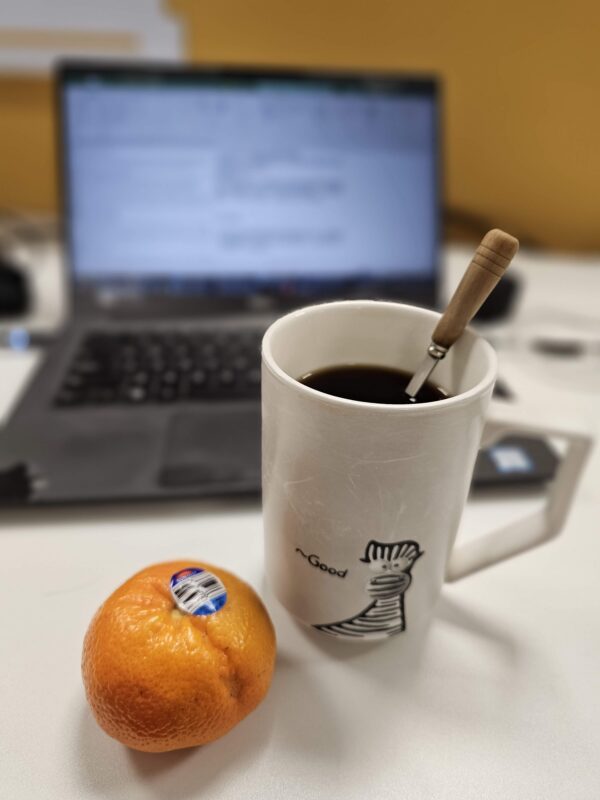
🎶i have a coffee, i have a clementine
uh! coffee-clementine!

i have a coffee, i have a comp
uh! comp-coffee!

clementine-coffee, comp-coffee
uh! coffee-comp-clementine-coffee 🎶

a reflection on “芸芸众生,日日忙忙碌碌何为?”

there’s only one certainty in life since birth — death.
but the time in-between birth to death is unknown to the individual (while some pple may argue that some higher beings/deities know/control/pre-determined it).
what would then one need to do to pass the time in-between?
ironically, the first thing is to find sustenance, to sustain the ever-dying shell; regardless if you are humans or prokaryotes, you do the same. in the grown up world context, it would mean “earning a living”, for most is to find a job(s) to earn an income to find sustenance and obtain things, to prevent the shell from dying too fast.
when one is able to find sustenance, and there’s still energy and time and not yet time to rest/sleep to regain energy for finding sustenance, pple begin to choose things to do (e.g., entertainment, interests, hobbies).

and life goes on like that, day in day out, excluding ‘sudden death’ events, the shell slowly crawls towards the certainty.

so back to the question, 芸芸众生,日日忙忙碌碌何为?the answer is perhaps 为了不死,或知道会死但不要想太多?
so what’s death? would death means ‘nothing’ at t+1? i wouldnt know for sure, but perhaps ‘nothing’ is the conception for those who seek early ‘termination’ on the journey to certainty?

different religions (generally defined as a set of beliefs, practices, and moral codes that relate to the nature of the universe and the place of individuals within it) would have shed different lights on the question of “芸芸众生,日日忙忙碌碌何为?”. from a buddhist perspective, one is trapped in the worldly cycle of death and rebirth (aka samsara). and one truth in this trap is suffering (dukkha), which can refer to “direct suffering, being liable to suffering, a bodily painful feeling, or unsatisfactoriness, deficiency, insufficiency.” not sure if there’s another religion where suffering is absent, not there at all?

how to attain the end of suffering, the end of the cycle, and thus the 芸芸众生,日日忙忙碌碌? it would be to work towards enlightenment through eliminating ignorance and craving. the method is to follow the eightfold path (八正道): right understanding, right intention, right speech, right action, right livelihood, right effort, right mindfulness, and right concentration.

so if you are a 芸芸众生 like me reading this in the midst of 日日忙忙碌碌, perhaps you can find a way in your (religious) beliefs to explain the purpose of your 日日忙忙碌碌 and if there’s a way to seek an end to it, of cos unless you love work so much and also there’s no ‘suffering’ in life. for me, the eightfold path (八正道) would be a good start, if not a reminder (:

references:
https://www.britannica.com/topic/Buddhism/The-Four-Noble-Truths
https://www.bbc.co.uk/bitesize/guides/zg7297h/revision/3
https://www.bbc.co.uk/bitesize/guides/zyhmk2p/revision/1